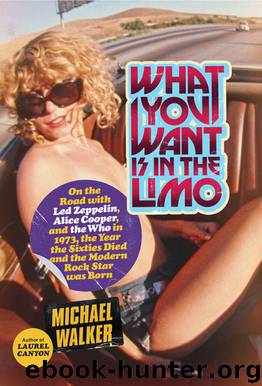
What You Want Is in the Limo: On the Road with Led Zeppelin, Alice Cooper, and the Who in 1973, the Year the Sixties Died and the Modern Rock Star Was Born by Michael Walker
Author:Michael Walker [Walker, Michael]
Language: eng
Format: epub
ISBN: 9780679644156
Publisher: Random House Publishing Group
Published: 2013-07-23T07:00:00+00:00
When the band plays Canada, Alice—who drinks beer all day, every day—refuses to drink Budweiser brewed there. “It had to be American,” says Bob Brown. “If we went to Canada, on the rider, it specifically said they had to import it from America. It would cause Libert and everyone else to go crazy if we found it said ‘bottled in Canada’ on it.” When Alice develops a phobia that he will be poisoned, promoters are instructed to provide bottles of Seagram’s VO, his other drink, with the Treasury seals intact. Compared to the no-brown-M&M’s backstage clauses immortalized during the 1980s, these demands seem almost trifling. (The infamous eleven-page Van Halen rider prohibiting brown M&M’s also stipulates, among literally hundreds of compulsories, three fifths of Jack Daniel’s Black Label, two fifths of Stolichnaya, one pint of Southern Comfort, two bottles of Blue Nun, four cases of Schlitz malt liquor, and one large tube of K-Y jelly.) But the fact that, starting in the seventies, the bands and their management cared enough to demand the very best and specify it in the contracts speaks volumes about their priorities and self-possession. From Starship to limo to hotel suite, when you’re a 1970s rock star, all the world’s a backstage. Which, as day follows night, gives rise to the backstage pass, ending whatever pretext of comity still exists between audience and performer.
“In the sixties it was like you were all one big family, there was no crowd control or security guards at the side entrances,” says Dave Otto, a Cincinnati entrepreneur who, like Bob Heil and Rusty Brutsche, saw a gap in the market and filled it. As rock moved into arenas, Otto perfected a technique for printing on flexible rayon with an adhesive backing. Thus was born the modern backstage pass. As Otto explains: “The cloth adheres well and goes with the contour of your body”—as untold groupies discover when applying one over a swelling halter-topped breast—“and does not fall off.” In short order, Otto’s backstage passes become the industry standard and a potent symbol of the stratification of rock culture as the audience-performer dynamic shifts to star and supplicant. “There was a mystique about them,” acknowledges Otto. “A backstage pass was more valuable than a front row seat ticket.” Before long they become pseudo-currency—groupies deduce the fastest route to the backstage sanctum is through a pass proffered by a roadie rounding up talent for the postshow party or, for the brazen, in an unsolicited exchange of fee for service, the latter earning the humble passes the sobriquet “knee pads.”
All of these entitlements breed an insidious contempt for the throngs herded into the arenas who buy the tickets and the albums. The rise of festival seating during the early seventies—no reserved seats and no chairs at all on the arena floor, which maximizes capacity and profits and forces audiences to stand the entire performance—is casual evidence of the cavalier attitude toward the “fans” from the backstage sanctum. Otto vividly recalls festival seating’s crush at the stage-front barricades.
Download
This site does not store any files on its server. We only index and link to content provided by other sites. Please contact the content providers to delete copyright contents if any and email us, we'll remove relevant links or contents immediately.
Cecilia; Or, Memoirs of an Heiress — Volume 2 by Fanny Burney(32088)
Cecilia; Or, Memoirs of an Heiress — Volume 3 by Fanny Burney(32065)
Fanny Burney by Claire Harman(26722)
We're Going to Need More Wine by Gabrielle Union(19168)
Plagued by Fire by Paul Hendrickson(17537)
All the Missing Girls by Megan Miranda(16697)
Cat's cradle by Kurt Vonnegut(15555)
For the Love of Europe by Rick Steves(14909)
Bombshells: Glamour Girls of a Lifetime by Sullivan Steve(14217)
Leonardo da Vinci by Walter Isaacson(13508)
4 3 2 1: A Novel by Paul Auster(12611)
The remains of the day by Kazuo Ishiguro(9220)
Adultolescence by Gabbie Hanna(9022)
Note to Self by Connor Franta(7749)
Diary of a Player by Brad Paisley(7717)
Giovanni's Room by James Baldwin(7546)
What Does This Button Do? by Bruce Dickinson(6315)
Ego Is the Enemy by Ryan Holiday(5621)
Born a Crime by Trevor Noah(5488)
